.33 Win. Load Data & Reloading Guide
Also known as: .33 Winchester, .33 WCF, .33 Winchester Center Fire
About .33 Win.
The .33 Winchester, introduced in 1903 by the Winchester Repeating Arms Company, was originally designed for the Winchester Model 1886 lever-action rifle. This caliber was developed during a period of innovation aimed at enhancing the capabilities of lever-action rifles, providing a significant power boost over the popular .30-30 Winchester of the time. While it was eventually overshadowed by later cartridges such as the .348 Winchester, the .33 Winchester remains of interest to collectors and reloaders who appreciate its historical significance and unique role in early 20th-century ballistics.
Technically, the .33 Winchester employs a rimmed, bottleneck case, with a case length of 2.105 inches and a bullet diameter of .338 inches. Factory loads commonly featured a 200-grain bullet, capable of reaching muzzle velocities around 2,200 feet per second. However, handloaders have the flexibility to explore various bullet weights, with some choosing to load 180-grain bullets for higher velocities or heavier bullets for enhanced stopping power. Its relatively moderate pressure loadings make it an excellent candidate for reloaders who are interested in maximizing case life and fine-tuning their loads for specific rifle characteristics.
Ballistically, the .33 Winchester offers a flat trajectory and substantial energy, suitable for hunting medium to large game at ranges under 200 yards. Its performance is often compared to the larger .348 Winchester, albeit with slightly less power. Nonetheless, in its time, it provided excellent performance for hunters targeting deer, elk, and bear in North America. The combination of its manageable recoil and potent game-stopping power makes it an enduring choice for lever-action aficionados.
For reloaders, the .33 Winchester presents specific advantages such as the opportunity to produce personalized loads tailored to vintage rifles, many of which may have unique bore conditions or mechanical tweaks. Reloaders can experiment with more modern powders and bullets than those available when the cartridge was first introduced, potentially enhancing velocity and accuracy. Brass for the .33 Winchester can sometimes be formed from parent cases such as the .45-70 Government, giving meticulous reloaders options to overcome challenges in sourcing factory brass. Those invested in handloading the .33 Winchester often do so to preserve the historical legacy of this classic cartridge and to ensure its continued use in well-maintained vintage firearms.
Technical Drawing
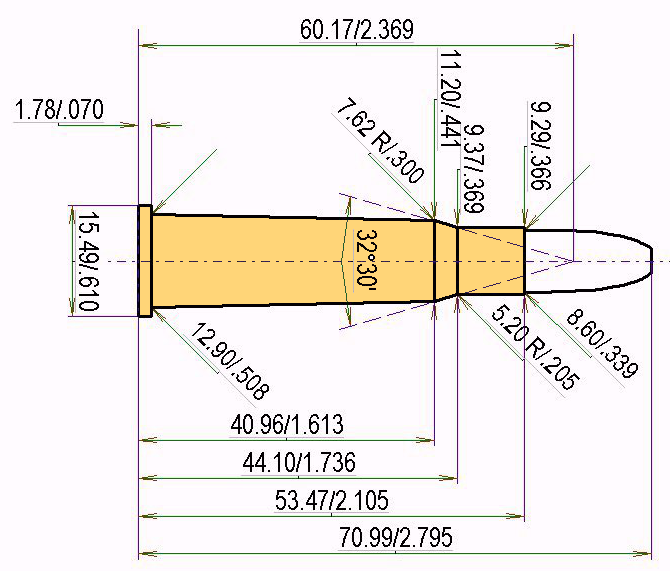
Technical Specifications
Start Calculating to Develop your own Load Data for .33 Win.
Use our professional ballistics calculator to develop safe and accurate load recipes for .33 Win..
Start CalculatingStandard Load Data — .33 Win.
Select your desired cartridge and bullet weight below to access the corresponding load table. From there, you can choose any listed load recipe and transfer it directly into the ballistics calculator for further refinement, optimization, and precision tuning.

.338 | 200gr | Peregrine VLR-4

.338 | 250gr | Barnes Banded Solid

.338 | 225gr | Hornady InterLock
.338 | 200gr | Alaska Bullet Works Kodiak SP SPBC

.338 | 200gr | NorthFork Bonded Core

.338 | 200gr | Nosler Ballistic Silver Tip
.338 | 200gr | Hornady InterLock FP
.338 | 250gr | Nosler Partition RN

.338 | 250gr | A-Square LionLoad
.338 | 210gr | Barnes TSX BT

.338 | 225gr | Sierra Pro-Hunter

.338 | 210gr | Rhino Penetrator
.338 | 225gr | Nosler Partition

.338 | 225gr | Woodleigh PP SN

.338 | 225gr | Speer Boat-Tail
.338 | 200gr | Alaska Bullet Works Kodiak SP SPFN
.338 | 225gr | Alaska Bullet Works Kodiak PP SPBC
.338 | 225gr | NorthFork Bonded Core

.338 | 200gr | Federal Fusion
.338 | 230gr | Nosler CT FailSafe

.338 | 225gr | Brenneke TOG

.338 | 200gr | Winchester Powerpoint
.338 | 275gr | Alaska Bullet Works Kodiak SP SPBC
.338 | 190gr | Brenneke TAG
Frequently Asked Questions
The maximum pressure for .33 Win. is 44,237 psi | 3,050 bar.
.33 Win. typically uses a Large Rifle (LR) primer.
The case capacity of .33 Win. is approximately 63 grains of water (H₂O).