.35 Rem. Load Data & Reloading Guide
Also known as: .35 Remington, .35 Remington Rifle, .35 Remington Express
About .35 Rem.
The .35 Remington cartridge was introduced in 1906 by the Remington Arms Company as part of its series of rounds designed for use in the semi-automatic Remington Model 8 rifle. It was developed during a period when the market was eager for medium to large game hunting rounds that could operate reliably in semi-automatic actions. It has since gained popularity among lever-action rifle enthusiasts, particularly those who have rifles chambered for this caliber like the Marlin 336.
The .35 Remington possesses a case length of 1.920 inches and typically uses a bullet diameter of .358 inches. It is rimless, bottlenecked, and designed primarily for medium-range shooting. The round typically achieves a muzzle velocity in the range of 1900 to 2100 feet per second with energy levels suitable for medium to large game hunting. Common bullet weights for the .35 Remington include 150, 180, and 200 grains, with the 200-grain bullet being the most popular for hunting due to its balance of energy transfer and trajectory.
In terms of practical applications, the .35 Remington is celebrated primarily for its success in thick brush or woods hunting. Its manageable recoil and effective ballistic performance make it a trusted choice for deer, black bear, and similar-sized game, especially in areas where shots are typically taken at moderate ranges. Although not typically seen in competitive shooting circles, it is a favorite among hunters seeking a classic cartridge with proven effectiveness.
For reloaders, the .35 Remington offers several advantages. Components are readily available, and reloading this caliber can be done economically, especially considering the price of factory ammunition. Reloading also allows enthusiasts to optimize loads for specific firearms, tweaking bullet weights and powder charges to achieve ideal performance for particular hunting situations. This flexibility ensures that the .35 Remington remains a viable and versatile cartridge for the reloading community.
Technical Drawing
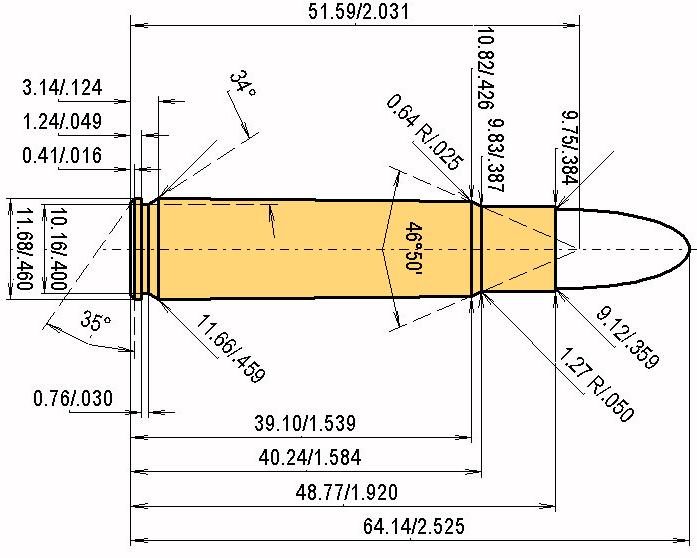
Technical Specifications
Start Calculating to Develop your own Load Data for .35 Rem.
Use our professional ballistics calculator to develop safe and accurate load recipes for .35 Rem..
Start CalculatingStandard Load Data — .35 Rem.
Select your desired cartridge and bullet weight below to access the corresponding load table. From there, you can choose any listed load recipe and transfer it directly into the ballistics calculator for further refinement, optimization, and precision tuning.

.358 | 200gr | Hornady InterLock RN

.358 | 158gr | Rim Rock SWC Gas Check
.358 | 200gr | Hornady FTX

.358 | 200gr | Winchester Powerpoint

.358 | 180gr | Speer Hot-Cor

.355 | 123gr | MEN FMJ RN
.358 | 180gr | Rim Rock TC
.358 | 180gr | Rim Rock LBT-WFN Gas Check

.357 | 158gr | Ares RNBB

.355 | 154gr | Geco FMJ FLAT NOSE
.357 | 125gr | Hornady XTP

.358 | 200gr | Fox Classic Hunter
.357 | 93gr | MEN PEP

.357 | 180gr | Swift A-Frame

.358 | 200gr | Remington SP Core-Lokt
.358 | 200gr | Winchester SPFN Powerpoint
.358 | 210gr | Reichenberg HDB Universal

.358 | 200gr | Rhino Solid Shank
.358 | 200gr | Hornady InterLock SP-RP

.357 | 158gr | LOS SWC

.355 | 180gr | Nosler Straight Wall

.356 | 150gr | Sierra FPJ FN
.358 | 180gr | Speer FP
.356 | 145gr | LOS HP
Frequently Asked Questions
The maximum pressure for .35 Rem. is 39,885 psi | 2,750 bar.
.35 Rem. typically uses a Large Rifle (LR) primer.
The case capacity of .35 Rem. is approximately 51 grains of water (H₂O).